
IELTS GT Writing Task 1 Letter Tips
Write a band-raising General Training Task 1 letter: formal, semi-formal and informal tone, full bullet-point coverage, a reliable structure, and common band killers.
What General Training Task 1 asks for
General Training Task 1 replaces the Academic chart or diagram with a letter: at least 150 words, in about 20 minutes, responding to a everyday situation such as a complaint, a request, an explanation or an invitation. Every prompt gives two or three bullet points that you must cover, and missing even one bullet caps your Task Achievement score regardless of how fluent the rest of the letter reads.
Unlike Academic Task 1, there is no data to summarise and no overview sentence to write. Instead, the letter is judged on situational appropriacy: did you choose the right tone for the relationship between writer and reader, and did you organise the letter the way a real reader would expect.
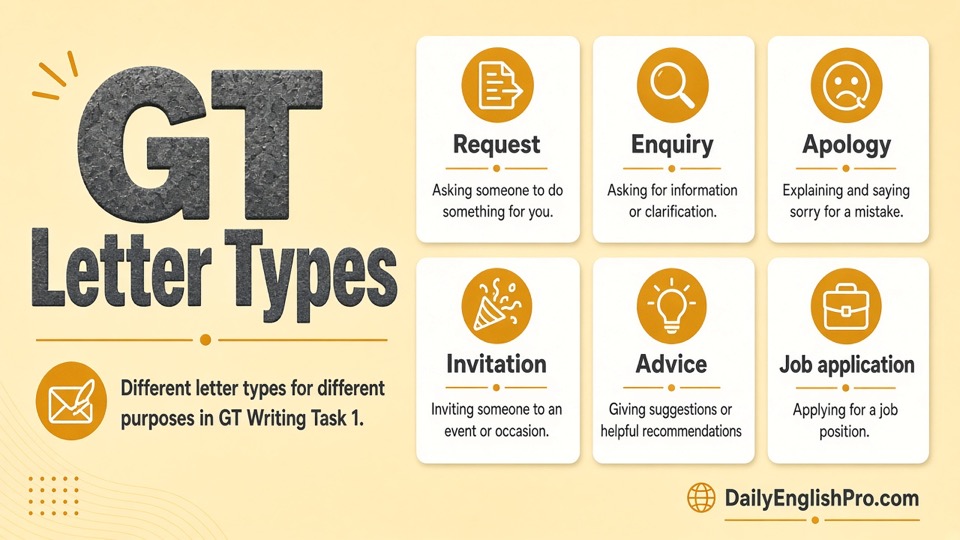
- Tone and register - Formal, semi-formal and informal
- Request letters - Clear purpose and polite asks
- Enquiry letters - Ask the right questions
- Apology letters - Admit, explain and amend
- Invitation letters - Event details readers need
- Advice letters - Options plus a recommendation
- Job applications - Fit, evidence and interview ask
Three letter types: formal, semi-formal and informal
The prompt tells you who you are writing to, and that relationship decides your letter type before you write a single sentence. Getting the type wrong, for example writing a friend a letter in a stiff, formal register, is penalised under Coherence and Cohesion even if the grammar is accurate.
| Type | Recipient | Typical situation |
|---|---|---|
| Formal | Someone you do not know personally: a company, a landlord, a council office | A complaint, a formal request, a job-related enquiry |
| Semi-formal | Someone you know a little: a manager, a neighbour, a service provider you have dealt with before | Asking a favour, explaining a problem, requesting a change |
| Informal | A friend or family member | Sharing news, inviting someone, asking for casual help |
Tone words that match each type
Tone is carried mostly by the greeting, the closing, and the level of directness in the middle. Mixing registers within one letter, for example a formal greeting followed by casual slang, is one of the fastest ways to lose marks even when every sentence is grammatically correct on its own.
Distant, polite
Formal
Dear Sir or Madam / Dear Mr Patel, I am writing to ... Yours faithfully / Yours sincerely.
- •No contractions (I am, not I'm)
- •Indirect requests: I would be grateful if
- •Full name in the closing signature
Polite, familiar
Semi-formal
Dear Mr Patel, I hope this email finds you well. Best wishes / Kind regards.
- •Occasional contractions are fine
- •Direct but polite requests
- •First name or first plus last name
Warm, casual
Informal
Hi Sam, Hope you're doing well! Take care / See you soon.
- •Contractions and casual phrasing expected
- •Short, friendly sentences
- •First name only, no formal closing
Covering every bullet point without padding
Each bullet point is worth roughly equal weight, so a letter that develops the first bullet in detail and rushes the last one in a single sentence still loses Task Achievement marks. Spend a similar number of sentences on each bullet, and resist the urge to pad word count with information the prompt never asked for.
- Underline every bullet point before you plan a single sentence of the letter.
- Give each bullet its own short paragraph or clearly separate section within a paragraph.
- Add one relevant detail per bullet (a date, a reason, a specific request) rather than a vague general statement.
- Do not invent a fourth topic the prompt never mentioned just to reach the word count.
A reliable four-part structure
- 1Greeting and opening lineMatch the greeting to the letter type, then state the reason for writing in one clear sentence.
- 2Bullet one, developedCover the first required point with one specific detail, not just a restatement of the bullet's wording.
- 3Bullet two (and three), developedGive each remaining bullet similar space and at least one concrete detail or reason.
- 4Closing line and sign-offEnd with a purpose-matching line (looking forward to hearing from you / hope to see you soon) and the correct closing for the tone.
Common band killers in GT Task 1 letters
A small set of mistakes appears repeatedly across General Training Task 1 letters, and most of them are easy to fix once you know to look for them in your own writing.
- Wrong register for the relationship stated in the prompt, such as slang in a formal complaint letter.
- Missing or under-developed bullet point, which caps Task Achievement even with strong grammar elsewhere.
- Under-length letters below 150 words, or letters padded with irrelevant detail to reach the count.
- A closing that does not match the greeting, for example Yours faithfully after a Dear Mr Patel greeting.
- No clear paragraph breaks between bullets, which makes the letter read like a single unstructured block.
Worked mini case: turning bullets into an outline
Take a common prompt: write to your landlord explaining that your washing machine is broken. In your letter, explain what the problem is, say how long it has been broken, and ask them to arrange a repair. This is a semi-formal letter, since a landlord is usually someone you know a little but not personally.
| Bullet | One-sentence outline |
|---|---|
| What the problem is | The washing machine in the kitchen stopped draining water properly last week. |
| How long it has been broken | It has not worked correctly for about ten days now, despite trying to reset it twice. |
| Ask them to arrange a repair | Could you please arrange for someone to look at it as soon as possible. |
Practice loop and frequently asked questions
Rotate between the three letter types deliberately rather than always practising the type you find easiest, since the real exam can give any of the three. A simple loop: plan the tone and bullets for three minutes, write for fifteen, then check the register and bullet coverage against Writing Checker before moving to a new prompt.
How is a GT letter different from Academic Task 1?+
Academic Task 1 summarises a chart, map or process with no personal tone involved. GT Task 1 is a letter that requires you to judge the correct register (formal, semi-formal or informal) for a real-world relationship, with no data at all.
Do I need a subject line or address?+
No. IELTS letters do not require an address, date line or subject heading in the way a real business letter might. Start directly with the greeting.
Can I use the same closing for every letter type?+
No. Yours faithfully suits formal letters to an unnamed recipient, Yours sincerely suits formal letters to a named recipient, and Best wishes or a simple sign-off suits semi-formal and informal letters.
What if my letter runs under 150 words?+
You will likely lose Task Achievement marks even if every sentence is accurate. Plan roughly 40 to 50 words per bullet point so the letter naturally reaches or exceeds the minimum.