
IELTS Writing Task 2 Essay Types Explained Clearly
Identify every IELTS Writing Task 2 essay type, choose the right structure, avoid task response mistakes, and plan a focused answer.
Why essay type controls your whole answer
IELTS Writing Task 2 gives you a topic and an instruction. The topic may concern education, transport, health, work, or another public issue. The instruction tells you what thinking the examiner expects. A candidate can write accurate English about the topic and still lose Task Response marks by answering the wrong question.
Most prompts fit five useful families: opinion, discussion, problems and solutions, advantages and disadvantages, and two-part questions. These labels do not appear on the test paper, so recognise them from the instruction words. Read the final sentence twice, then turn every requested action into a checklist. If it says discuss both views and give your opinion, your answer has three jobs, not one.
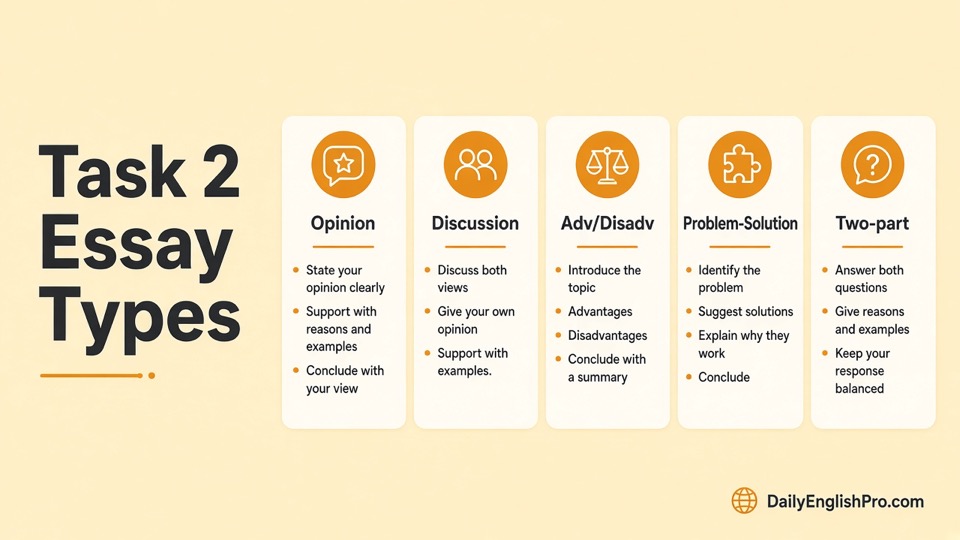
| Essay type | Common instruction | Your task |
|---|---|---|
| Opinion | To what extent do you agree or disagree? | State the extent and support it throughout |
| Discussion | Discuss both views and give your opinion | Explain both views and give a judgement |
| Problems and solutions | What problems arise and how can they be solved? | Link specific problems to realistic solutions |
| Advantages and disadvantages | Do the advantages outweigh the disadvantages? | Develop both sides and compare their weight |
| Two-part question | Why is this happening? Is it positive? | Answer both direct questions fully |
- Agree / disagree deep dive - Thesis, two-body support and partial-agreement traps
- Discussion essay deep dive - Fair views plus a clear personal judgement
- Advantages / disadvantages - Discuss both sides or decide which outweighs
- Problem / solution - Link each problem to a realistic fix
- Two-part questions - Give Q1 and Q2 equal coverage
Separate opinion essays from discussion essays
An opinion prompt asks for your position. You may agree completely, disagree completely, or take a qualified view, but the reader should never have to guess. A practical structure is an introduction, two supporting body paragraphs, and a conclusion. If you partly agree, define the limit precisely instead of changing sides between paragraphs.
A discussion prompt supplies two stated views. Explain why reasonable people support each view before confirming your judgement. You can state your opinion in the introduction and make it visible while discussing the stronger side. A separate opinion paragraph is unnecessary when your view is already clear and developed. Fair discussion does not mean giving both views the same number of words; it means representing each accurately.
Defend a position
Opinion essay
Each body paragraph gives a distinct reason supporting the stated extent of agreement.
- •State the extent
- •Develop two reasons
- •Keep the conclusion consistent
Explain both views
Discussion essay
Each side receives a fair explanation, followed by a clear personal judgement.
- •Represent both views
- •Explain their reasoning
- •Include your opinion when asked
Match problems with solutions and weigh advantages
Problems and solutions essays are strongest when the parts connect. If a problem is that rural residents cannot reach hospitals, a matching solution might be subsidised mobile clinics. A proposal such as improve society is too vague. Some prompts ask for causes rather than problems. A cause explains why a situation happens; a problem describes a harmful result. Do not treat these words as interchangeable.
Advantages and disadvantages prompts also vary. Discuss the advantages and disadvantages requests both sides but does not explicitly demand a final comparison. Do the advantages outweigh the disadvantages does. For an outweigh essay, choose your judgement before writing and show why one side matters more in scale, likelihood, reversibility, or long-term effect. Counting two benefits against one drawback is not evaluation.
- Name the exact problem, cause, advantage, or disadvantage in the topic sentence
- Explain the mechanism by showing how or why the effect occurs
- Use one plausible example rather than an unsupported statistic
- For solutions, identify who acts and what that action changes
- For outweigh prompts, compare importance rather than counting points
Give two-part questions two complete answers
A two-part prompt places two questions after the topic statement. It may ask for reasons and effects, causes and opinions, or whether a trend is positive and how governments should respond. The safest plan usually gives one body paragraph to each question. This makes coverage visible and prevents the first answer from consuming most of your time.
Consider this prompt: More employees now work from home. Why has this change occurred? Is it a positive or negative development? Body paragraph one could explain collaboration technology and lower office costs. Body paragraph two could judge the trend as mainly positive because of flexibility and reduced commuting, while acknowledging isolation as a manageable limitation. Each paragraph now has a defined job, and the conclusion can answer both parts in one sentence.
- 1Separate the questionsUnderline each question and label it Q1 or Q2 in your plan.
- 2Choose one developed answerGive each question an idea, explanation, and relevant example.
- 3Check balanceAllow similar space for both answers unless one clearly requires more detail.
- 4Confirm the conclusionMake sure the final judgement reflects both answers rather than only the second.
Plan the correct structure before you write
Use three to five minutes to identify the type, decide your position, and select two main ideas. Write a short paragraph map. For an opinion essay about subsidised transport, that might be B1: lower household travel costs; B2: wider access to employment. This is more useful than a vocabulary list because it controls the logic of the answer.
Avoid templates filled with sentences that could introduce any topic. A concise introduction needs a paraphrase and a direct answer. A body paragraph needs a controlling idea, explanation, and example. The conclusion summarises the answer without new evidence. During review, compare every paragraph with the task checklist. Remove any sentence that is generally related to the topic but does not help answer the instruction.
Essay type questions students often ask
Recognising the family is a planning tool, not a reason to force every prompt into an identical template. Practise by collecting ten prompts, hiding the topics, and classifying only the instruction lines. Then write a position and two paragraph jobs for each one.
Can one prompt combine two essay types?+
Yes. A prompt may ask why a trend is happening and whether it is positive. Follow the actual instructions and develop every requested part.
Must I discuss both sides in an opinion essay?+
No. You may defend one side with two strong reasons. A counterargument helps only when you answer it clearly and keep your position consistent.
How many body paragraphs should I write?+
Two developed body paragraphs work for most prompts. Three can work, but extra paragraphs often reduce development and increase time pressure.
What if I misidentify the type?+
The label is not scored, but missing an instruction can seriously limit Task Response. Check every task word rather than relying only on a category name.