
IELTS Writing Task 1 Process Diagram Tips
Describe IELTS Academic Task 1 process diagrams with accurate sequence language, controlled passive voice and a five-stage worked model.
What process diagrams test
A process diagram shows how a product is made, how a system works, or how a natural cycle develops. Your report must identify the start and end, give a clear overview, and describe the stages in the correct order. You are not expected to add scientific knowledge that the visual does not provide.
Processes may be linear, cyclical or branching. A linear manufacturing process ends with a finished product. A natural cycle returns to its starting state. A branching process may divide one material into different outputs. Identify the process shape before writing, because it controls your overview and sequencing.
| Process type | Overview focus | Language priority |
|---|---|---|
| Linear | Number of stages, raw input to final product | from, through, finally |
| Cyclical | Repeated loop with no permanent endpoint | returns to, begins again, cycle |
| Branching | One stream divides or multiple streams combine | is separated into, converges, respectively |
| Natural | Main phases and transformations | active or passive based on visible agent |
| Manufacturing | Materials, treatment and packaging | passive voice often dominates |
Plan the sequence before writing
Spend two minutes numbering the main stages and identifying where materials change form. Group short connected actions into one sentence when they belong to the same phase. If a process has five stages, you might use one body paragraph for collection and treatment, then another for filling, sealing and distribution.
- 1Find the inputIdentify the raw material, source or event at the first arrow.
- 2Trace every arrowFollow the exact route and note any split, return or parallel action.
- 3Number major stagesUse a simple 1 to 5 or 1 to 7 sequence rather than writing sentences immediately.
- 4Mark transformationsNotice where material is filtered, heated, mixed, cooled, shaped or packaged.
- 5Choose two detail groupsSeparate preparation from finishing, or natural development from return to the start.
- Include each labelled stage at least once.
- Do not invent temperature, duration or purpose unless shown.
- Keep arrows in order even when the visual layout moves up or sideways.
- State if the cycle repeats, rather than calling the final visible box a permanent end.
Sequence language that shows relationships
Sequence words should clarify the route, not decorate every sentence. First and finally are useful at boundaries, while once, after which and before being show tighter relationships between consecutive actions. Repeating then at the start of every sentence sounds mechanical and does not reveal whether actions overlap or depend on one another.
| Relationship | Useful language | Example |
|---|---|---|
| Starting | initially, the process begins with | The process begins with water being drawn from a spring. |
| Next stage | next, subsequently, after this | Subsequently, the liquid enters a filter. |
| Dependent action | once, after which, before being | Once purified, the water is transferred to a tank. |
| Simultaneous | while, at the same time, meanwhile | Meanwhile, empty bottles are cleaned. |
| Ending | finally, the process concludes with | Finally, the bottles are packed for delivery. |
Passive voice without awkward writing
Manufacturing diagrams often omit the worker or machine responsible for an action. Passive voice keeps attention on the material: water is filtered, bottles are filled, labels are attached. Use active voice when a visible subject naturally performs the action, such as a pump sends water to a tank.
Invented agent
Forced active
Workers filter the water and workers fill the bottles.
- •Agent may not be shown
- •Repetition distracts
- •Focus leaves the process
Process-focused
Controlled passive
The water is filtered before being transferred to the filling machine.
- •No invented agent
- •Stages connect
- •Material remains the subject
| Base action | Useful passive form | Common error |
|---|---|---|
| filter | is filtered | is filter |
| send | is sent | is send |
| seal | are sealed | are seal |
| transport | is transported | is transporting |
| freeze | is frozen | is freezed |
Worked five-stage bottled-water process
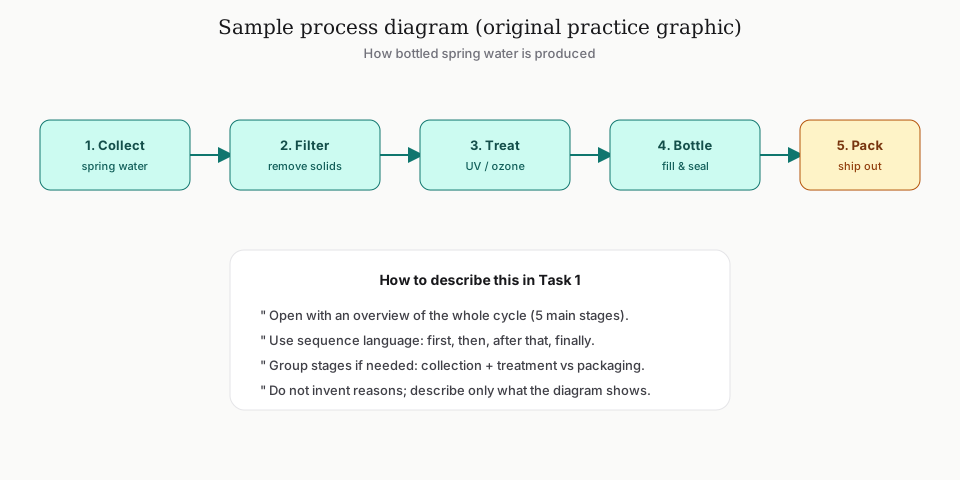
Use the original diagram below as a five-stage practice task. A sensible stage count is collection, filtration, storage, bottling and distribution. The strongest overview names the overall route and notes that treatment happens before packaging, without listing every pipe or machine.
Short model detail paragraph
Model body: Initially, raw water is collected and passed through a filtration unit, where unwanted material is removed. The purified water is then transferred to a storage tank before being directed to the filling stage. At the same time, empty bottles are prepared, after which they are filled with the treated water and sealed. In the final stage, labels are attached and the completed bottles are packed into cases for delivery.
This paragraph follows the arrows, uses passive forms where no agent is shown, and combines small actions without losing a stage. It does not invent chemical treatment, temperatures or journey times. The phrase at the same time should only be used if the diagram indicates bottle preparation occurs in parallel.
| Model feature | Scoring value |
|---|---|
| where unwanted material is removed | Adds a controlled relative clause and states the visible function |
| before being directed | Links sequence while avoiding another short sentence |
| after which | Shows the next dependent action clearly |
| completed bottles | Uses concise referencing instead of repeating treated and sealed bottles |
Common errors, practice and FAQs
The largest Task Achievement errors are missing a stage, misreading a cycle as linear, or adding unsupported explanations. Language errors often come from passive forms, subject-verb agreement and repetitive sequencing. Check the arrows once after writing and underline every verb to verify its form.
- Do not write a separate sentence for every icon if two actions form one clear phase.
- Do not use the imperative, such as filter the water, because you are reporting rather than instructing.
- Avoid personal opinions about whether the process is efficient or environmentally friendly.
- Check that is, are, was and were agree with each process subject.
- Keep the overview broad and place technical detail in body paragraphs.
Do I need passive voice in every sentence?+
No. Use it when the agent is unknown or unimportant. A visible machine or natural force can be an active subject.
Should I state the exact number of stages?+
Yes when the stages are clear and defensible. If several tiny actions make counting uncertain, describe the broad phases instead.
Can I add the purpose of a stage?+
Only when the diagram makes that purpose clear. Do not add outside technical knowledge.
Does a process report need a conclusion?+
No. The overview gives the big picture, and a separate conclusion usually repeats it.
- Academic Task 1 guide - Review overview, timing and paragraph structure.
- Writing practice - Rotate process, map and chart prompts.
- Full mock tests - Complete Task 1 while protecting Task 2 time.
- Compare plans - Explore writing practice and feedback access.