
IELTS GT Enquiry Letter Tips (2026)
Write a clear IELTS General Training enquiry letter: request information with organised questions that cover every bullet, formal tone tips, sample outline and FAQ.
Enquiry letters ask for information
An enquiry letter (also called a request for information) asks an organisation for facts you need before you decide: course content, fees, schedules, facilities, or membership rules. Unlike a request for action such as posting a lost item, the main goal is clear answers.
Formal tone is usual because you often write to a school, club, council or company you do not know personally. Polite questions should still be direct enough that staff can reply point by point.
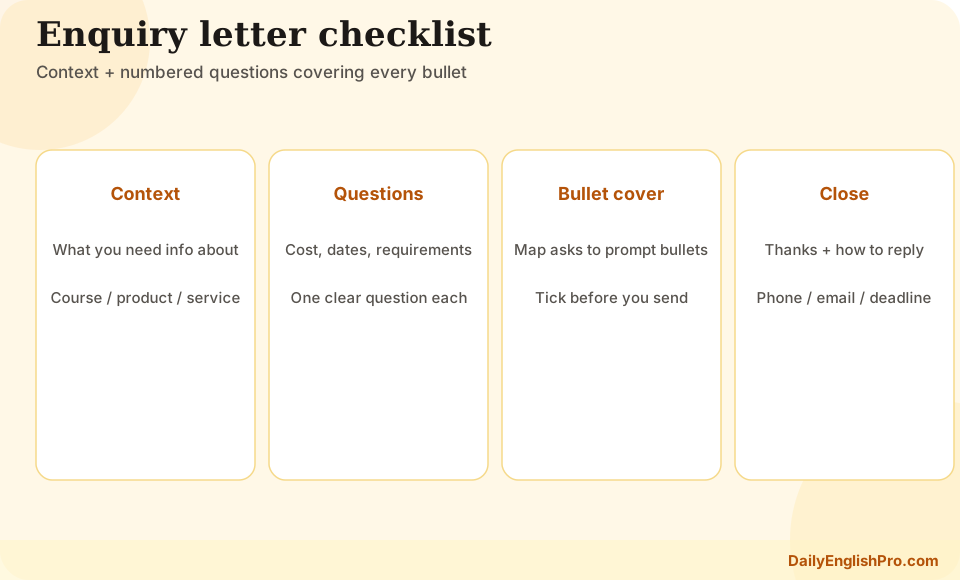
Turn bullets into answerable questions
If a bullet says ask about course content, do not write only Please tell me about the course. Ask what topics are covered, whether there is a practical project, and how many hours of teaching there are per week.
Group related questions in one paragraph per bullet. That structure makes Task Achievement easy to see and helps the reader respond.
| Bullet theme | Weak question | Stronger question set |
|---|---|---|
| Content | What is the course? | Which modules are included, and is there a final project? |
| Schedule | When is it? | What are the start dates, session times and total duration? |
| Staff / cost | Is it good? | What qualifications do tutors hold, and what is the full fee? |
- 1State purposeName the course, product or service you saw advertised.
- 2Add brief contextSay why you need the information.
- 3Ask by bulletOne paragraph of clear questions per requirement.
- 4Close politelyThank them and say you look forward to the details.
Sample outline for a course enquiry
Prompt idea: You are interested in an intensive digital skills course. Write to the academy. Ask about course content, the weekly schedule, and the instructors' qualifications.
Outline: Dear Sir or Madam; interest in Intensive Digital Skills (July intake) seen on the website; questions on modules and software taught; timetable for weekday evenings and total weeks; tutor industry background and certifications; thanks; Yours faithfully.
Weak
Scattered enquiry
Can you tell me everything about the course and also other courses you have?
- •Too broad
- •Off prompt
- •Hard to answer
Strong
Focused enquiry
Could you please outline the modules for the July Intensive Digital Skills course, confirm whether classes run 6-9 p.m. on weekdays, and summarise the tutors' professional qualifications?
- •Matches bullets
- •Specific intake
- •Actionable
Polite question language
Formal enquiries often use I would be grateful if you could... or Could you please confirm... Indirect questions (I wonder whether...) are fine if they stay clear. Avoid stacking five unrelated asks into one sentence.
- I am writing to enquire about...
- I would be grateful if you could provide details of...
- Could you please confirm whether...
- I would also like to know...
- Please let me know how I should apply / register / pay...
- Thank you in advance for your assistance. I look forward to hearing from you.
- Purpose names the exact course or service
- Each bullet becomes clear question content
- Tone stays formal and consistent
- Closing thanks the reader and invites a reply
Enquiry vs request: know the difference
Use an enquiry pattern when you need facts. Use a request pattern when you need the reader to perform an action such as sending a document or changing a booking. Some letters mix both: ask for information and then request a brochure. Keep each aim in its own paragraph.
Cross-check related guides so you pick the right strategy under timed conditions.
Enquiry letter FAQ
Drill five prompts by writing only the three question paragraphs in eight minutes. Then add openings and closings in a second pass.
How many questions should I ask?+
Enough to cover each bullet fully. Often two focused questions per bullet is plenty.
Can I ask about something outside the bullets?+
Stay centred on the bullets. One short extra line is acceptable only if it clearly supports the purpose.
Is enquiry the same as request?+
Enquiry seeks information. Request seeks action. Read the prompt verbs carefully.
Should I use a numbered list of questions?+
Better to use short paragraphs. Lists can look like notes rather than a letter.