
IELTS GT Request Letter Tips (2026)
Write a clear IELTS General Training request letter: purpose, background, polite specific asks, sample outline, original useful phrases, FAQ and timed practice.
What a request letter must achieve
A request letter asks someone to do something: return a document, change a booking, send materials, or help with a practical problem. In IELTS GT Task 1, the prompt usually gives a short situation and three bullets. Your job is to make the ask clear while giving enough background for the reader to act.
Tone depends on the reader. A training centre administrator needs formal or careful semi-formal language. A flatmate or friend can receive a warmer informal request. In every case, specificity beats drama.
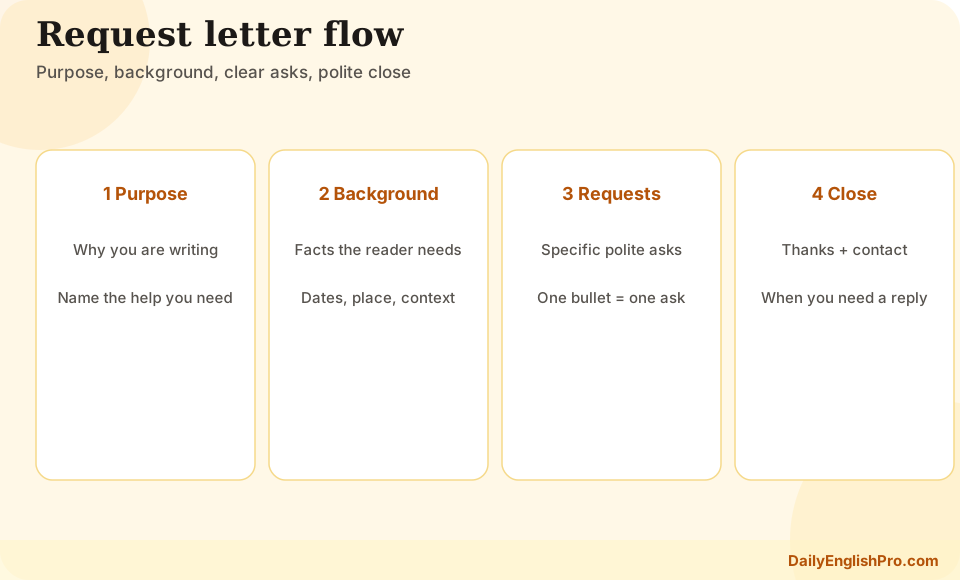
Map the three bullets before you write
Typical request prompts ask you to explain why you need help, describe what was left behind or what went wrong, and say what you would like the person to do. Cover each verb with concrete detail. Why you need a certificate is different from where you left it and how you want it returned.
Invent plausible facts: course name, dates, full name on a document, preferred collection method. Keep those facts consistent across paragraphs.
| Bullet job | What to invent | Reader needs |
|---|---|---|
| Background / why | Course, booking, or reason the item matters | Motivation and urgency |
| Describe the item or problem | Name, date, location, distinctive detail | Ability to identify the issue |
| Request action | Replacement, collection, email, appointment | A clear next step |
- 1Open with purposeI am writing to request help with...
- 2Give backgroundOne short paragraph on when and why.
- 3Describe the needSpecific item, problem or missing information.
- 4Ask preciselyState the preferred action and contact detail if useful.
Sample outline for a formal request
Sample prompt idea: You finished a weekend photography workshop and left your printed certificate at the venue. Write to the centre coordinator. Explain why you need the certificate, describe where you think you left it, and say how you would like it returned.
Outline: Dear Ms Okonkwo; purpose and workshop dates; why the certificate is needed for a freelance client file; likely left on the registration desk after the Sunday critique; request that it be posted to your address or held for collection on Friday; thanks and Yours sincerely.
Weak
Vague request
Please help me with my certificate somehow.
- •No identifier
- •No method
- •Hard to act on
Strong
Specific request
Could you please post the certificate for Maya Chen, Weekend Photography Studio, 12-13 April, to the address below, or hold it for collection this Friday after 4 p.m.?
- •Name and course
- •Two options
- •Clear timing
Useful phrases (original, adaptable)
Learn functional chunks, then change the nouns every time. Do not paste a memorised paragraph that ignores the prompt. Pair polite modals with concrete nouns so the request stays natural and precise.
- I am writing to request assistance with...
- I would be grateful if you could locate / arrange / confirm...
- The document is needed as proof of... for...
- I believe I left it at / near...
- Please could you post it to... or hold it for collection on...
- If you need any further details, I can be reached at...
- Purpose appears in the first paragraph
- Each bullet has at least one supporting detail
- The final ask is specific and polite
- Tone matches the reader from greeting to closing
Common request-letter mistakes
Candidates often explain the story for too long and rush the actual ask into one weak sentence. Others demand action in an aggressive tone, or forget a contact method when the organisation needs to reply.
Another trap is copying the bullet wording as a list. Write full paragraphs. In informal requests to friends, stay warm but still cover every bullet with usable detail.
Request letter FAQ and next practice
Practise one formal and one informal request in the same week. Keep the planning method identical: reader, purpose, two notes per bullet, then write.
How polite should a request be?+
Polite enough for the relationship, and clear enough to act on. Formal letters use grateful / appreciate with a specific action; informal letters can use Could you...?
Should I offer two options?+
Often yes, when both are realistic, such as post or collect. Do not invent complicated logistics that confuse the reader.
Can I invent an address or phone number?+
Yes, if the situation needs one. Keep it simple and consistent.
Is a request letter always formal?+
No. Requests to friends are informal. Requests to organisations are usually formal.