
IELTS Task 2 Agree Disagree Essay Tips (2026)
Master IELTS Writing Task 2 agree/disagree and to what extent essays with clear theses, two-body support, partial-agreement traps, a checklist and FAQ for Band 7 Task Response.
Recognise agree/disagree and to what extent prompts
Agree/disagree Task 2 prompts ask you to take a clear personal position on a statement. Typical wording includes Do you agree or disagree? and To what extent do you agree or disagree? Both require an answer you can defend across the essay. The topic statement itself is not the question; the instruction line tells you what the examiner must see in your thesis.
Education, transport and work prompts are common. A statement such as All university education should be free so that more people can study is followed by Do you agree or disagree? Your job is not to list every related idea about higher education. You must decide whether you agree, disagree, or agree only to a defined extent, then prove that judgement with two developed reasons.
| Prompt cue | What you must do | Risky response |
|---|---|---|
| Do you agree or disagree? | Choose a side and defend it | Neutral summary with no position |
| To what extent do you agree? | State full, large, partial or no agreement | Vague both sides are important |
| How far do you agree? | Same as to what extent | Discussing causes instead of agreement |
Build a thesis that answers the instruction
A Band 7 thesis states the degree of agreement and briefly signals the main reasons. For a free-university prompt, a clear thesis might be: I largely agree that tuition should be free for first degrees because access widens opportunity and a better-educated workforce supports public services, provided that places remain selective. The reader already knows your side, your main lines of argument and the limit you will control.
Avoid empty openings such as This is a controversial issue with many opinions. They waste words and delay Task Response. Paraphrase the topic in one sentence, then give the thesis. First-person phrases such as I agree or In my view are acceptable; a direct evaluative sentence works equally well if the position is unmistakable.
Weak
Unclear thesis
University fees are complicated, so governments should think carefully about education policy.
- •No degree of agreement
- •No direction for the body
- •Sounds like a discussion opener
Stronger
Clear thesis
I disagree that all university education should be free because unrestricted places would strain budgets and lower incentives to finish demanding courses.
- •Explicit disagreement
- •Two reasons previewed
- •Body paragraphs have jobs
Develop two body paragraphs that prove the thesis
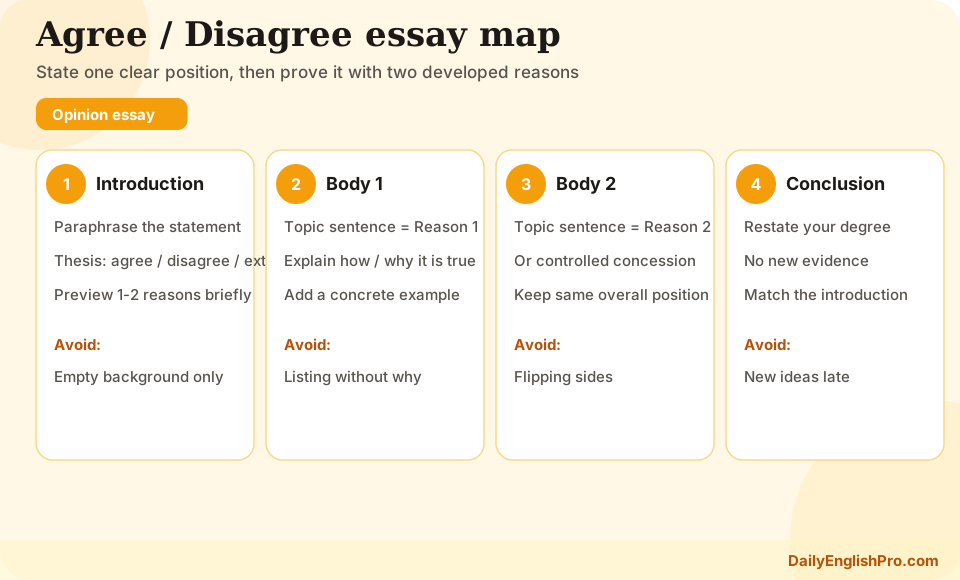
Most agree/disagree essays work best with two body paragraphs. Each paragraph should carry one controlling idea that supports your position. Explain the mechanism, then add a realistic illustration from education, transport or work. For example, if you argue that employers should fund job-related training, explain that staff can apply new skills immediately on current projects, then illustrate with a logistics firm that reduces delivery errors after subsidised software courses.
Keep examples general and plausible. You do not need published statistics. A sentence such as Many mid-size manufacturers report fewer machine stoppages after short in-house training courses is enough if the logic is clear. End each body with a consequence that reconnects to your thesis so the examiner sees continuous Task Response.
- 1Name the claimWrite the paragraph's answer in one short sentence that matches the thesis.
- 2Explain howShow the cause-effect chain that makes the claim true.
- 3IllustrateAdd one concrete education, transport or workplace scenario.
- 4Link backState why this evidence supports your degree of agreement.
- Body 1 and Body 2 must be different reasons, not the same idea rephrased
- Topic sentences should take a stance, not announce a theme
- Concessions belong only where they strengthen a partial-agreement plan
- Avoid packing three mini-arguments into one paragraph
Handle partial agreement without losing clarity
Partial agreement is allowed and often natural, but it is a common Band 6 trap. Candidates mention one benefit, then one drawback, and never say which side carries more weight. If you partly agree that cities should ban private cars from centres, state the main support (cleaner air, safer streets) and define the limit (access for deliveries and disabled residents). The qualification must be smaller than the main case, or the essay will read as undecided.
A reliable structure for partial agreement is: Body 1 develops the stronger side of your position; Body 2 presents the condition or exception and shows why it does not overturn the overall judgement. Do not give both sides equal space and then invent a strong preference only in the conclusion. The conclusion should restate the same degree you announced in the introduction.
| Approach | Body roles | When it works |
|---|---|---|
| Full agree / disagree | Two reasons for one side | You have two strong, distinct supports |
| Largely agree | Main reason + second reason with brief limit | One exception exists but does not dominate |
| Partly agree | Stronger side + controlled qualification | You can weigh both without flipping |
Pre-submit checklist for agree/disagree essays
Use the final five minutes for Task Response, not only grammar. Check that the introduction answers the instruction, that each body paragraph advances the same position, and that the conclusion does not upgrade a partial view into full agreement. Watch for accidental discussion-essay language such as On the one hand... On the other hand... when the task never asked you to present both views fairly.
Also check lexical precision on the topic. For transport essays, distinguish congestion, pollution and accessibility. For work essays, separate productivity, job security and training costs. Vague nouns such as things, problems and aspects weaken Band 7 Lexical Resource even when the structure is sound.
- Thesis states a clear degree of agreement
- Two body ideas prove that degree with explanation and example
- Any concession is weighed, not listed as equal
- Conclusion restates the same position without new evidence
- No missing task part (agree/disagree answered, not only topic described)
下一步練習
Frequently asked questions
Is to what extent different from agree or disagree?+
Both require a personal position. To what extent invites you to state how strongly you agree, including partial agreement, but you still need a clear overall answer.
Can I discuss both sides in an agree/disagree essay?+
You may acknowledge the other side briefly if it supports a controlled partial view. Do not turn the essay into a balanced discussion without a dominant position.
How many reasons do I need for Band 7?+
Two well-developed reasons are usually enough. One thin reason repeated with synonyms will not meet Task Response expectations.
Should my opinion appear only in the conclusion?+
No. State it in the introduction and keep the body consistent. Leaving the position until the end often looks unclear.