
IELTS Task 2 Two-Part Question Tips (2026)
Answer IELTS Task 2 two-part questions with equal coverage, tight planning, clear structures for why/why not and positive/negative variants, plus a Band 7 FAQ.
Treat both questions as equal Task Response jobs
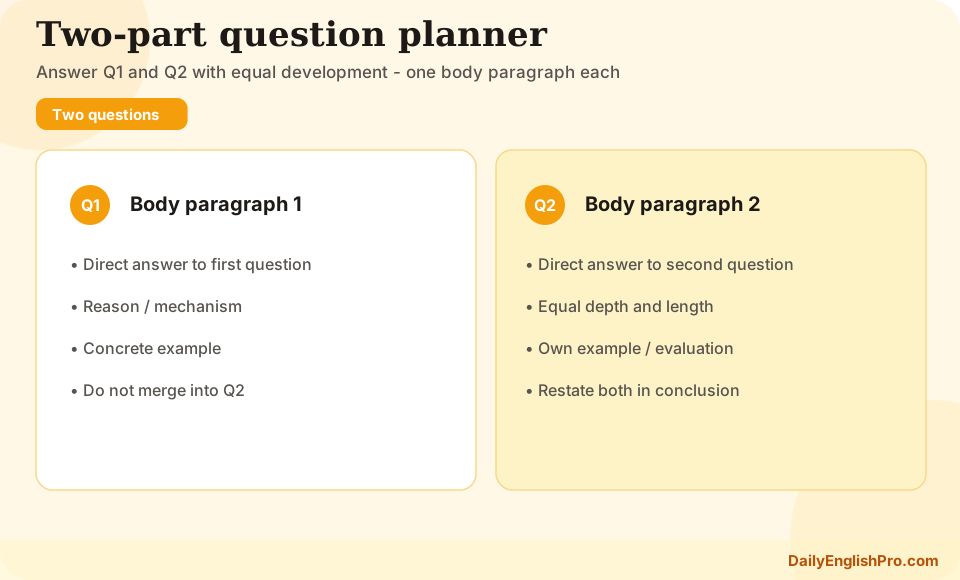
Two-part Task 2 prompts ask two direct questions after a short statement. A common pattern is: Why is this happening? Is it a positive or negative development? Another is: What are the reasons? What problems can it cause? Each question needs a developed answer. Writing a strong paragraph for Question 1 and a thin sentence for Question 2 is one of the fastest ways to lose Task Response marks.
Underline Q1 and Q2 separately during the first minute. Turn each into a planning note. If the topic is more young people choosing short contract work instead of long-term jobs, Q1 might ask for reasons and Q2 for effects on workers or society. Your essay fails if it only explains reasons brilliantly and never addresses effects.
| Question pair | Body 1 | Body 2 |
|---|---|---|
| Why + positive/negative? | Main reasons | Overall judgement with support |
| Reasons + problems? | Reasons | Problems linked to those reasons |
| Reasons + solutions? | Reasons | Solutions targeting the reasons |
| What + how? | Explain what/why | Explain how/measures |
Plan both answers before you write a word
Spend four to five minutes planning. Write Q1 answer in eight words, then Q2 answer in eight words. Add one supporting idea under each. Only then paraphrase the topic. Candidates who start writing immediately often discover in minute 25 that Question 2 still has no content, which forces a rushed, undeveloped final paragraph.
Check overlap. If Q1 reasons and Q2 problems use the same sentences, rewrite so each paragraph has a distinct job. Reasons explain drivers; problems explain harmful results; positive/negative judgements evaluate the overall development. Keeping these functions separate makes Coherence easier and prevents repetition.
- 1Label Q1 and Q2Circle the two question marks or imperative verbs in the rubric.
- 2Draft micro-answersOne short claim for each question before collecting examples.
- 3Choose supportAdd one education, transport or work illustration per body.
- 4Write the thesis mapIntroduction should preview that both questions will be answered.
Handle why plus positive/negative variants
When Question 2 asks whether a trend is positive or negative, give a clear overall verdict. Do not hide behind It has both benefits and drawbacks unless you then state which matters more. For short-term contract work, you might argue the trend is largely negative for financial security even though it offers flexibility for a minority of skilled freelancers.
Body 1 can explain why the trend is growing: employers reduce fixed costs; some workers want varied projects. Body 2 then judges the development, using criteria such as income stability, training investment and long-term career progression. The judgement paragraph still needs explanation and an example, not only the words positive or negative.
Weak
Incomplete Q2
This development has advantages and disadvantages that should be considered carefully by society.
- •No verdict
- •No criterion
- •Looks evasive
Stronger
Clear Q2 judgement
Overall this is a negative development because unpredictable income makes housing and training harder for most young workers.
- •Direct evaluation
- •Reason given
- •Scope limited to most workers
- Preview both answers briefly in the introduction
- Keep Q1 focused on reasons or explanations, not judgement
- Keep Q2 focused on evaluation or the second required element
- Restate both answers in the conclusion in one compact sentence each
Balance coverage under the 40-minute limit
Aim for similar development depth, not identical word counts. If Q1 needs two causes, you can place both in Body 1 with clear sequencing. Body 2 must still look complete. A practical timing split is five minutes planning, twelve to thirteen minutes per body, three minutes for introduction and conclusion combined drafting, and five minutes checking that both questions were answered.
During the check, cover Body 2 and ask whether Q2 is identifiable. Then cover Body 1 and ask the same for Q1. If either answer depends on a single vague sentence, expand it by adding mechanism and example rather than new unrelated claims.
| Time block | Task | Output |
|---|---|---|
| 0-5 min | Analyse and plan | Q1 claim, Q2 claim, examples |
| 5-8 min | Introduction | Paraphrase + preview both answers |
| 8-21 min | Body 1 | Full answer to Q1 |
| 21-34 min | Body 2 | Full answer to Q2 |
| 34-40 min | Conclusion + check | Both answers restated; coverage confirmed |
Sample outline: short contracts and young workers
Statement: An increasing number of young people take short-term contracts rather than permanent jobs. Why is this happening? Is it a positive or negative development?
Introduction: paraphrase the trend; preview labour-market reasons and a largely negative judgement. Body 1: firms prefer flexible staffing; some graduates use contracts to sample industries. Body 2: overall negative because unstable income and weaker training reduce long-term security. Conclusion: restate causes and the negative verdict.
- Q1 answered with explanation and example
- Q2 answered with a clear judgement or second element
- Introduction previews both
- Conclusion repeats both without new claims
- No accidental switch into a pure discuss-both-views essay
次の練習
Frequently asked questions
How many paragraphs should a two-part essay have?+
Four is usually enough: introduction, one body for each question, and a conclusion. Add a fifth only if a question truly needs separate space.
Can one example serve both questions?+
Better to give each body its own support. Reusing the same example for both answers often looks repetitive and thin.
What if the two questions overlap?+
Separate functions carefully. For example, keep causes in Body 1 and effects or evaluation in Body 2, even if the topic words are similar.
Do I need to write equal word counts for each part?+
Aim for balanced development. Exact equality is unnecessary, but neither answer should be a single undeveloped sentence.