
IELTS Task 2 Discussion Essay Tips (2026)
Learn how to write IELTS Task 2 discussion essays that present both views fairly, place your opinion clearly, avoid one-sided answers and use a reliable Band 7 outline.
What a discussion essay must cover
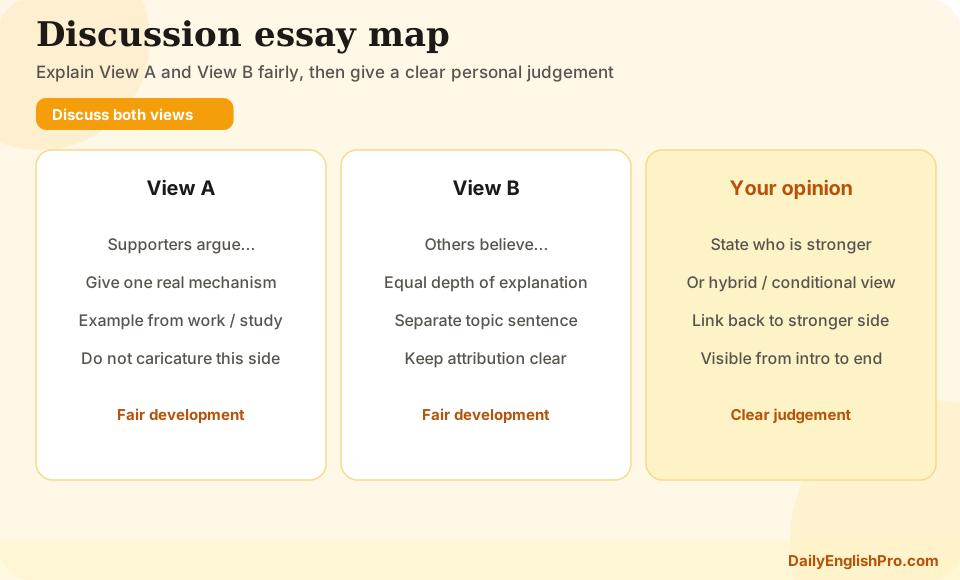
A discussion Task 2 prompt usually says Discuss both these views and give your own opinion. That is three jobs: explain View A, explain View B, and make your judgement clear. Missing any part damages Task Response. The topic may involve education choices, commuting patterns or workplace culture, but the scoring focus is completeness and balance of treatment, not which side you prefer.
Read the two views carefully. They are often contrasts such as Some people think employees should work from offices; others believe remote work is more productive. Your paraphrase must keep both claims intact. Do not rewrite the prompt into a single agree/disagree question, or you will answer the wrong task.
| Task part | Examiner expectation | Common miss |
|---|---|---|
| View A | Fair reason and explanation | One dismissive sentence |
| View B | Fair reason and explanation | Copying View A with antonyms |
| Your opinion | Clear judgement linked to the discussion | Hidden until a vague conclusion |
Develop each view with genuine reasons
Fair development means each view gets a real argument, not a caricature. For a remote-work discussion, View A might argue that offices support mentoring and spontaneous problem-solving. View B might argue that remote schedules reduce commuting fatigue and let staff focus on deep tasks. Explain the mechanism for each side before you evaluate.
Use topic sentences that attribute the view: Supporters of office work argue that... or Those who favour remote arrangements claim that... This signalling helps Coherence and Cohesion and reminds you not to collapse both sides into your own voice too early. After the explanation, one workplace or education example keeps the paragraph concrete.
Weak
One-sided discussion
Remote work is better. Offices are outdated and waste time. Therefore remote work should replace offices.
- •View A barely explained
- •Sounds like agree/disagree
- •Opinion replaces discussion
Stronger
Fair then evaluative
Offices can speed mentoring for juniors, while remote setups can raise focus for experienced staff. On balance, a hybrid model serves most teams better.
- •Both views given logic
- •Opinion follows understanding
- •Clear final preference
Where to place your opinion
You can state your opinion in the introduction and reinforce it after discussing both views, or introduce both views first and deliver your judgement in Body 2 and the conclusion. Either approach works if the position is early enough for the examiner to track. The risky pattern is a fully neutral body followed by a sudden preference in the last sentence.
When your opinion matches one view, still explain the other view respectfully, then show why your preferred view is stronger. When you prefer a middle position, such as hybrid working, say so explicitly and explain how it combines the main strengths of both sides. A compromise is only clear if you name it and justify the balance.
- 1Paraphrase both viewsKeep the contrast accurate in one or two opening sentences.
- 2Signal your stanceAdd a thesis such as I lean towards View B because... or I support a balanced approach because...
- 3Explain View AGive a real reason, mechanism and brief example.
- 4Explain View B and evaluateDevelop the second view, then show which argument carries more weight for you.
- Do not invent a third unrelated debate in the body
- Avoid equal word counts if one view needs a short concession only
- Never ridicule a view you disagree with
- Keep the conclusion aligned with the thesis degree
Avoid turning discussion into a one-sided essay
One-sided answers usually happen when candidates prefer agree/disagree habits. They write two paragraphs for their favourite view and mention the other view in a single clause. Examiners treat that as incomplete. Another failure mode is listing advantages of both sides without ever saying which you support. Discussion plus opinion is not a pure advantages list.
Language can also reveal imbalance. If every evaluative adjective appears only on one side (effective, practical, outdated, unrealistic), check whether the weaker side still received a fair reason. You can evaluate firmly after explaining; you should not refuse to explain.
Sample outline for a work-from-home prompt
Prompt idea: Some people believe staff should work in offices every day. Others think remote work is more productive. Discuss both views and give your opinion.
Introduction: paraphrase the contrast, then state that a hybrid model is preferable. Body 1: office presence aids mentoring, team coordination and faster feedback for junior staff. Body 2: remote days reduce commute stress and protect deep-work time; overall, two or three office days plus remote focus days capture both benefits. Conclusion: restate hybrid preference without new evidence.
| Paragraph | Job | Example focus |
|---|---|---|
| Introduction | Contrast + opinion | Hybrid working preferred |
| Body 1 | View A developed | Mentoring in offices |
| Body 2 | View B + judgement | Deep work at home, then weigh |
| Conclusion | Restate judgement | Hybrid as practical compromise |
التمرين التالي
Frequently asked questions
Do both views need the same number of words?+
Not exactly. Each view needs genuine development. Your preferred side can be slightly longer if the other side is still explained fairly.
Can my opinion appear only in the conclusion?+
It is safer to signal it earlier. A conclusion-only opinion often looks like an afterthought and can hurt Task Response clarity.
What if I agree equally with both views?+
Say that clearly and explain the conditions under which each view works, or propose a combined approach such as a hybrid policy.
Is discuss both views the same as advantages and disadvantages?+
No. Discussion essays present two perspectives held by people. Advantages/disadvantages essays evaluate features of one idea or policy.